|
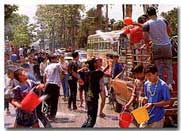 Songkran Festival (13-15
Apr) Songkran Festival (13-15
Apr)
The traditional Thai New Year, joyfully celebrated throughout the country
with rituals of merit making, cleaning houses, honouring elders, parades
of dancers and music troupes, and boat races. What makes the festival
most interesting is water splashing, an amusing way to make you cool
in the hot season. It is celebrated in a grand way in Chiang Mai and
at Phra Pradaeng near Bangkok.
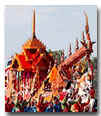 Rocket Festival ( around the
2nd weekend of May) Rocket Festival ( around the
2nd weekend of May)
Called "ngan bun bang fai" in Thai, it is a unique festival of the Northeast,
most elaborately celebrated in Yasothon province. Bamboo rockets are
launched as an annual plea to gods for plenty of rainfall in the rainy
season The festival also includes sacrificial rites, a colourful procession
of country folk dances and a beauty contest.
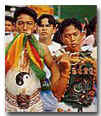 Vegetarian Festival (around
29 Sept - 7 Oct) Vegetarian Festival (around
29 Sept - 7 Oct)
People of Chinese origin in Phuket and Trang provinces make merit by
abstaining from food and oil from animals, holding processions of god
statues along the streets and observing traditional magical rites as
a sacrifice to their gods.
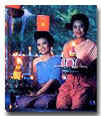 Loy Krathong or Festival of
Light (11 Nov, the full-moon day) Loy Krathong or Festival of
Light (11 Nov, the full-moon day)
The romantic night festival, people gather at the waterside to float
krathongs, lotus-shaped vessels lovely decorated with flowers and lit
candles, as a thanksgiving and worship to the Goddess of Water. Magnificent
celebrations are held in Sukhothai and Chiang Mai.
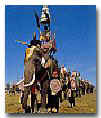 Surin Elephant Round-up (18-19
Nov) Surin Elephant Round-up (18-19
Nov)
Surin, a northeastern province, is famous of its greatest number of elephants
and its world-famous elephant round-up. The show features elephant football,
elephant race and hunt. Elephants in ancient battle and demonstrations
of their strength and skills.
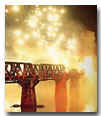 The River Kwai Bridge Week
(26 Nov - 7 Dec) The River Kwai Bridge Week
(26 Nov - 7 Dec)
Held in Kanchanaburi province to commemorate the horrible ordeal suffered
in the construction of the Death Railway to be used by the Japanese army
as a route of supply from Thailand to Burma in World War II. The festival
features a historical exhibition, fun fair, bazaar and exciting light & sound
presentation.
 The biggest gold Buddha image The biggest gold Buddha image
Phra Sukhothai Traimit or the Gold Buddha of Wat Traimit,
Bangkok. Cast in 5 ? tons of solid gold in the Sukhothai style,
this statue measures 3.10 m across the laps and 3.91 m high from
base to top, and is the largest gold Buddhist stature in the
world. It is estimated to be 700-800 years old but had been mistaken
for an ordinary stucco image until May 1955.
The highest mountain
Doi Inthanon is one of the most frequently visited national
parks of Thailand. A 47-km first class road leads from the plain
of Chiang Mai (about 300 m above sea level) gradually up to the
2,565-metre summit.
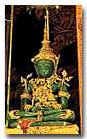 The most precious Buddha image The most precious Buddha image
"Phra Kaeo Morakot" or the Emerald Buddha, which almost
all foreign visitors to Bangkok have seen or will see at the
Temple of the Emerald Buddha, is held by the Thai people as a
priceless national treasure, much more valuable than even the
solid gold statue mentioned above. It was carved from a single
block of fine jade across the taps and 66 cm. Sitting posture,
it was 48.3 cm wide across the laps and 66 cm. High from base
to top.
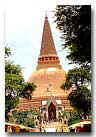 The tallest Buddhist pagoda The tallest Buddhist pagoda
Phra Pathom Chedi, in the heart of the provincial town
of Nakhon Pathom, 56 km west of Bangkok, is 120.45 m high and
is the tallest Buddhist monument of the world. The original stupa
was built many centuries ago and was rebuilt to its present height
in 1853 by King Rama IV, who had been in the Buddhist monkhood
for 27 years before ascending the throne.
The province with the biggest elephant population
Surin in the Northest bordering Cambodia is known as
the home of elephants. They are reared by local farmers as domestic
animals like cattle. The annual Elephant Round-up, a well known
event in the tourist circles, is held in Surin at the third weekend
of November.
The largest crocodile
Over 6 m long and a hybrid from a fresh-water crocodile
and a saltwater one, it is kept in Samutprakarn Crocodele Farm,
The biggest of its kind in the world. The reptile is 27 years
old and weighs 1,114.27 kg. |